The idea
Malayalam has a strong short-story tradition, and a lot of new writing happens in school competitions, college magazines and WhatsApp groups. Very little of it ends up on a page that Google can index. Search for a Malayalam short story by name and you mostly find PDFs, scanned pages or social posts.
Cherukatha.com (ചെറുകഥ means “short story”) is our answer: a simple platform where anyone can register, publish a story in Malayalam, and get a permanent page for it with their name on it. Readers get a clean reading experience. Writers get an audience and a link they can share.
Because this is our own product, it is also the project where I get to test SEO ideas without a client deadline.
The challenge
User-generated content platforms have a specific SEO problem. The home page is not what people search for. They search for a story title, an author name, or a phrase like “malayalam short stories” or “മലയാളം ചെറുകഥ”. If each story is not a proper page with its own URL, title and metadata, the platform is invisible no matter how good the writing is.
There were three constraints on top of that:
- Searches happen in two scripts: Malayalam (ചെറുകഥ) and transliterated English (cherukatha, katha).
- Malayalam typography needs care. A story is unreadable if the font renders conjuncts badly.
- The platform had to work on cheap Android phones on mobile data, because that is where readers are.
Content and keyword strategy
The strategy is built on one principle: the writers create the content, the platform creates the SEO. Every product decision below follows from that.
| Query type | Example | Page that targets it |
|---|---|---|
| Category, Malayalam script | മലയാളം ചെറുകഥകൾ | Home page title: “ചെറുകഥ - മലയാള ചെറുകഥകൾ” |
| Category, transliterated | malayalam short stories, cherukatha | Domain name plus the English tagline “Read Malayalam Short Stories” in the header |
| Story title | ശൂന്യതാ വിലാപം | Individual story page |
| Author name | Bibin S malayalam story | Story slug contains the author; writer profile page lists all their stories |
| Context / event | kalolsavam malayalam short story | Story metadata (school, competition, grade) rendered as text on the page |
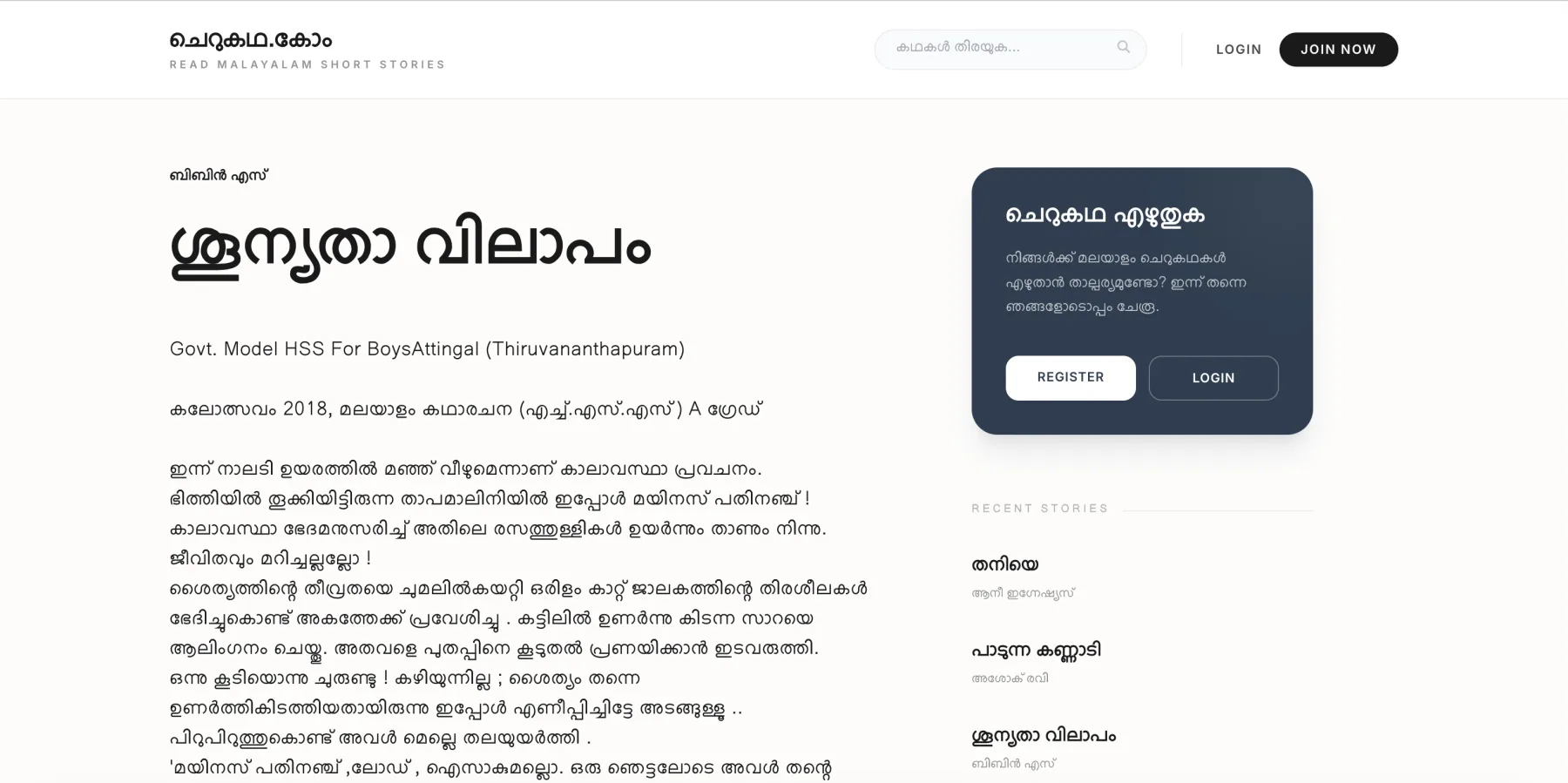
The last row is the interesting one. Many stories on the platform were written for the Kerala School Kalolsavam. That context is stored as structured metadata and printed on the page, so a story can be found by the event it was written for, not just by its title.
What was built
URL design
Story URLs are descriptive, transliterated slugs rather than IDs. A real example from the site:
/story/malayalam-short-story-written-by-bibin-s-kerala-school-kalolsavam
That single URL carries the category (“malayalam short story”), the author, and the event. It is readable in a WhatsApp preview and it is readable to Google. Writers get their own profile URL under /writer/ that lists everything they have published.
Home page as a reading page
Most platforms make the home page a grid of cards. Cherukatha’s home page opens with a full story: author, title, context, and the complete text. The sidebar carries a “write a short story” call to action, a Recent Stories list and Recent Comments. This does two jobs at once. Readers start reading immediately, and Google sees a page with real long-form Malayalam text that changes as new stories are published.
The application
- Registration and login, so writers own their stories and profile.
- A story editor with fields for the author’s context (school, competition, award), which becomes on-page text.
- Search in Malayalam (“കഥകൾ തിരയുക…”) across titles and authors.
- Comments on stories, listed on the home page as fresh content.
- A privacy and terms page, which matters for a site that stores user accounts.
Typography and performance
The HTML declares lang="ml" so browsers and search engines treat the content as Malayalam. Body text uses a Malayalam-optimised font paired with Inter for the interface, at a large reading size with generous line height. The interface is Tailwind-based and lightweight, and story pages are plain HTML text, so they load quickly on a slow connection.
What we are measuring
- Indexed story pages, tracked in Search Console. The whole strategy fails if stories do not get indexed.
- Impressions for Malayalam-script queries versus transliterated queries, to see which script is bringing readers.
- Writer registrations and stories published per month, because supply is the growth engine.
Search Console data will be published here
I only publish numbers I can screenshot. Impressions, clicks and average position for the target keyword cluster will be added once there is enough data to show a trend rather than a spike.
What is next
- Article schema on every story with the author, date and language, plus a Person entity for each writer profile.
- Open Graph tags per story so a shared link in WhatsApp shows the title and author. In Kerala, WhatsApp sharing is the distribution channel, and a rich preview is the difference between a tap and a scroll.
- An XML sitemap generated from the stories table, so new stories are discovered within hours rather than whenever Google recrawls the home page.
- Category and tag pages (love, humour, competition entries) to capture broader Malayalam queries.
Key takeaways
- On a user-generated platform, the URL is the SEO. Descriptive slugs with author and context outperform numeric IDs before you write a single meta tag.
- Target both scripts. Malayalam in the title, English transliteration in the tagline and slugs.
- Turn metadata into visible text. The school and competition fields exist for readers, but they are also long-tail keywords.
- Build supply first. Every writer you onboard is a page you did not have to write.