The business
Delma Scales & Measuring Devices LLC is a weighing-equipment supplier based in Sharjah’s Industrial Area 11. They sell platform scales, crane scales, analytical balances, label-printing scales, weighbridges, weighing indicators and load cells, and they install, calibrate and maintain them across the Emirates. They represent more than a dozen manufacturer brands.
Their customers are not consumers. A factory needs a 5-tonne platform scale calibrated. A supermarket needs label-printing scales for 20 counters. A logistics yard needs a truck weighbridge. Every one of those buyers does the same thing: they search Google for the product plus “UAE”, “Sharjah” or “Dubai”, open two or three suppliers, and call or WhatsApp the one that looks most credible.
The challenge
The old online presence was a set of directory listings. Delma existed on Yellow Pages UAE, Dun & Bradstreet and similar sites, but not on a page they controlled. That created two problems:
- For a product query like “load cell supplier UAE”, there was no page to rank. Directories rank for the company name, not for products.
- Even when a buyer found the company, there was nowhere to see the range, check the address or start a WhatsApp conversation.
The brief was a site that could rank for a family of supplier-intent keywords, present a large product range without becoming a catalogue nobody reads, and turn a visit into a phone call or WhatsApp message.
Keyword strategy
B2B industrial keywords in the UAE have modest volume, but the intent is very high and the searcher is usually the decision maker. So instead of one long home page, the strategy was one commercial keyword per page, with the home page owning the broadest term.
| Page | Target keyword | Title tag pattern |
|---|---|---|
| Home | weighing scale supplier in UAE | Weighing Scale Supplier In UAE | Delma |
| Industrial scales | industrial weighing machines UAE | Industrial Weighing Machines And Scales In UAE | Delma |
| Load cells | load cell sensor supplier UAE | Load Cell Sensor Supplier In UAE | Delma |
| Retail scales | retail weighing scale UAE | Same pattern |
| Weighbridge | truck weighbridge UAE | Same pattern |
| Indicators | weighing indicator UAE | Same pattern |
| Accessories, printers | supporting product queries | Same pattern |
| Services | weighing scale calibration UAE | Same pattern |
Every title follows the same formula: {product} Supplier In UAE | Delma. Boring on purpose. A buyer scanning results sees exactly what they typed, and the brand at the end builds recognition across repeat searches.
Underneath each category, the individual product types (compression load cell, S-type load cell, flame-proof indicator, silo and hopper scale, and so on, more than twenty in total) are H3 headings with a short description and an image. That captures long-tail product queries without needing twenty more pages.
Informational queries on the same page
Rather than a separate blog, the home page answers the questions buyers ask before they buy: “What is a weighing scale?”, “Calibration in weighing machines”, and a section titled “Common weighing scale complaints, answered” that covers inaccurate readings, inconsistent results, durability, battery life and design faults. Those are the exact phrases people type when their current scale is failing, which is the moment they start looking for a new supplier.
What was built
Site architecture
Eleven flat URLs with descriptive slugs (/industrial-weighing-scales.html, /load-cell-sensor.html, /weigh-bridge.html and so on), all listed in an XML sitemap, all linked from the main navigation and cross-linked from the home page product grids. No orphan pages, no pagination, no filters that generate duplicate URLs.
Home page structure
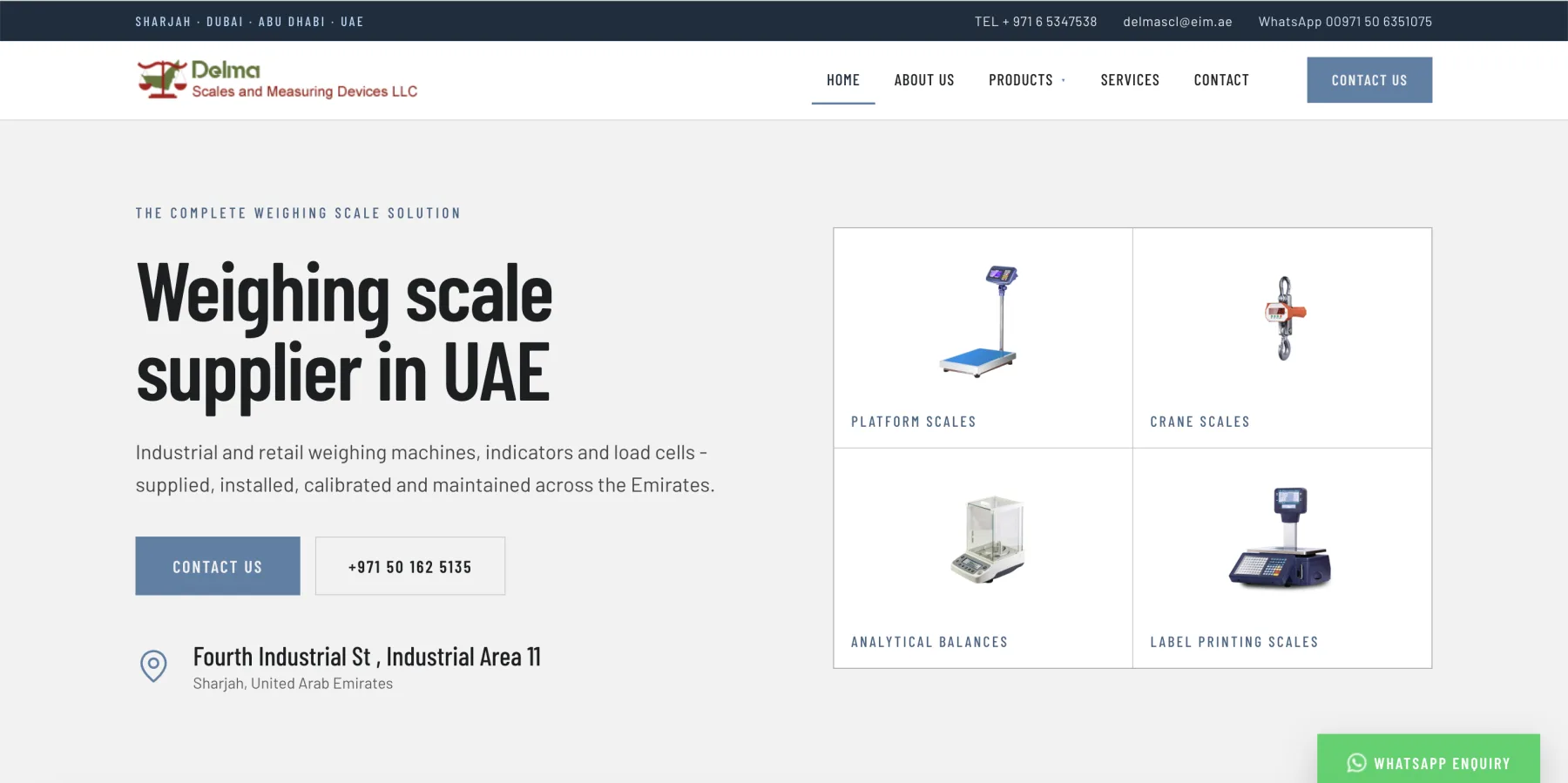
- Top bar: “Sharjah · Dubai · Abu Dhabi · UAE”, phone, email and WhatsApp number. Location signals in the first line of HTML.
- Hero: H1 “Weighing scale supplier in UAE”, one-sentence description, Contact button, phone number as a button, and the physical address with a map pin. A B2B buyer wants to know you are real and nearby before anything else.
- Featured product grids: machines, indicators and load cells, each item linking to its category page.
- Weighbridge and label-printing scale spotlights: the two highest-value product lines get their own sections.
- Why Delma and What we do: supply, installation, calibration, maintenance and consultation, written as services rather than adjectives.
- Educational sections and the complaints FAQ described above.
- Partners: manufacturer logos, which do a lot of trust work in this industry.
- Google Maps embed and full contact block.
Structured data
The site carries LocalBusiness JSON-LD with the legal name, URL, phone, email, PO box and Sharjah address, areaServed set to the United Arab Emirates, and sameAs links to the company’s Facebook, X, Instagram and Pinterest profiles. This ties the website to the same entity Google already knows from the directories and the Business Profile.
Technical checklist
- Hand-written static HTML with three scripts in total. No page builder, no jQuery plugins, no render-blocking framework.
- Every image served as WebP. 47 of 48 images have descriptive alt text, and 41 are lazy-loaded so the hero paints first.
- Canonical tag on every page,
robotsmeta set to index and follow,robots.txtpointing to the sitemap. - Open Graph and Twitter card tags with a dedicated share image, so links sent in WhatsApp show a proper preview.
- Barlow and Barlow Condensed fonts loaded from Google Fonts with preconnect, chosen because they read well at industrial-catalogue sizes.
Lead capture
There is no contact form on the home page. Instead there are seven WhatsApp links and five click-to-call links, plus a sticky green “WhatsApp Enquiry” button that stays visible while scrolling. Three different phone numbers are shown because the client’s sales staff each handle a region. Every enquiry goes to a human within seconds, which is how this industry expects to be served.
What we are measuring
- Search Console impressions and clicks for the “weighing scale supplier” cluster on the home page, and for each category page’s own keyword.
- Category page coverage: which of the eleven URLs are indexed and which product H3s are earning impressions.
- WhatsApp and phone taps as conversion events.
Search Console data will be published here
I only publish numbers I can screenshot. Impressions, clicks and average position for the target keyword cluster will be added once there is enough data to show a trend rather than a spike.
What is next
- FAQPage schema on the complaints section, so the questions can appear as rich results.
- Product schema on the category pages, one entity per product type.
- Emirate landing pages for Dubai and Abu Dhabi. The home page already lists them, but “weighing scale supplier in Dubai” deserves its own page with local delivery and calibration details.
- A short guides section for informational queries such as how often a platform scale needs calibration, which feed the services page.
Key takeaways
- One keyword per page, one page per keyword. For B2B suppliers this beats a single long home page every time.
- Use a title formula. Consistency reads as authority across a whole set of search results.
- Answer the failure questions. “My scale reads inconsistently” is a buying signal in disguise.
- Match the channel to the buyer. Industrial buyers call. Put the number everywhere and skip the form.