The business
Rajadhani Furniture is a furniture showroom on the main road in Kechery, a small town about 20 km from Thrissur city. They sell sofas, chairs and bedframes made from solid wood, and most of their customers come from Thrissur district. Sales happen in the showroom or over the phone. Before this project they had a Google Business Profile with reviews, but no website.
The owner was clear about one thing: they did not want an online store. Nobody in Kechery buys a ₹15,000 sofa with a card at midnight. People want to see the piece, ask a couple of questions, and negotiate delivery. In Kerala that conversation happens on WhatsApp.
The challenge
When you type “furniture shop in Thrissur” into Google, you get the map pack, a few directories and a couple of large brands. A small showroom with no website has no chance of showing up in the organic results, and even the map listing is weaker without a site to point to.
So the brief became:
- Rank for local, high-intent queries like “furniture shop in Thrissur” and “furniture Kechery”.
- Show real products with real prices, so the visit answers the questions people usually call about.
- Make WhatsApp the primary call to action, with the product name already typed into the message.
- Keep it cheap to host and simple to update. No CMS, no plugins to maintain.
Keyword strategy
I started with a short keyword list rather than a spreadsheet of hundreds. For a single-location retailer, three or four queries carry almost all of the value.
| Query | Intent | Where it lives on the page |
|---|---|---|
| furniture shop in Thrissur | Commercial, local | Eyebrow line above the H1, meta title, testimonials copy |
| affordable furniture Thrissur | Commercial, price-sensitive | “The best affordable furniture shop in Thrissur” line, prices on products |
| furniture Kechery / furniture shop Kechery | Navigational, local | “Visit our showroom in Kechery” H2, address block, map embed |
| sofa Thrissur, wooden chair Thrissur | Product-level | Product cards and their individual URLs |
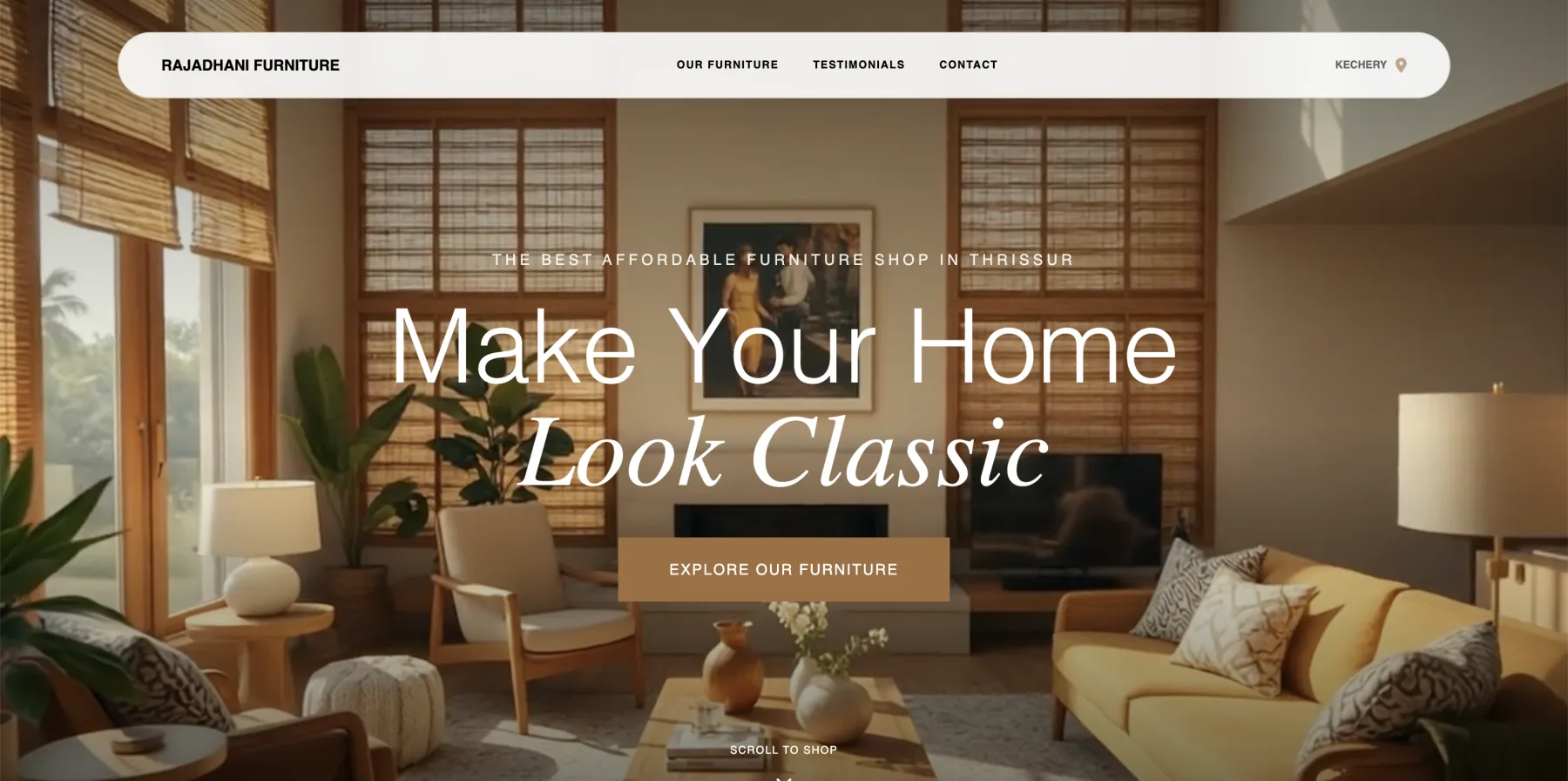
The important decision was not to force the keyword into the H1. The H1 is “Make Your Home Look Classic”, which is the brand promise. The keyword sits in the eyebrow text directly above it: “The best affordable furniture shop in Thrissur”. Google reads both. Visitors read a headline that sounds like a furniture brand, not like an SEO page.
Local SEO for a small shop is mostly about saying clearly, in text, where you are and what you sell. Everything else is secondary.
What was built
Page structure
The home page is a single long page, with each section written as an H2 that a search engine can read as a topic:
- Hero: eyebrow keyword line, brand H1, “Explore our furniture” button.
- Trust strip: Quality wood, carefully built, safe delivery, customer support.
- Curated spaces: living room (sofas and lounge chairs) and bedroom (premium bedframes).
- Our furniture: product cards with the actual price and a WhatsApp order button.
- Quality wood, made for Kerala homes and Built for everyday life: two short sections that answer the “why buy here” question in plain language.
- Words from our clients: Google reviews with the 4.7 rating shown.
- Visit our showroom in Kechery: address, phone, email and a Google Maps directions link.
WhatsApp instead of a cart
Every product has an “Order on WhatsApp” button. The link opens WhatsApp with a pre-filled message that already names the product, so the shop owner knows what the customer is asking about before saying hello. This is the single most useful feature on the site, and it cost nothing to build.
I use the same pattern on this site. If you tap “Get a Quote” at the top of this page, the message is already written.
Products as indexable pages
Each product also has its own URL (for example /furniture/1) listed in the sitemap, along with a /news page for showroom updates. This gives Google more than one page to rank and gives the owner a place to post new arrivals without touching the home page.
Technical checklist
- Static HTML, no framework or CMS. Three scripts in total.
- Canonical tag,
robots.txtallowing everything, and an XML sitemap. - Alt text on every image, WebP for the large lifestyle photos.
- Open Graph tags with
og:localeset toml_IN, since most sharing will happen in Malayalam WhatsApp groups. - Google Maps embed and a direct “Get directions” link, which also feeds the map-pack signals.
What we are measuring
Three things, in this order:
- Impressions and clicks in Google Search Console for the Thrissur and Kechery keyword cluster.
- WhatsApp taps from the product buttons, tracked as events.
- Direction requests from the showroom section.
Search Console data will be published here
I only publish numbers I can screenshot. Impressions, clicks and average position for the target keyword cluster will be added once there is enough data to show a trend rather than a spike.
What is next
The site is live and doing its job, but a few things are on the roadmap:
- FurnitureStore schema (a LocalBusiness type) with opening hours, and Product schema with price on each product page, so prices can appear directly in search results.
- A written meta description for the home page. It currently falls back to page text.
- More product pages. Two products is enough to prove the pattern, not enough to win product-level queries.
- A Malayalam version of the key sections, since a large share of local searches are typed in Malayalam.
Key takeaways
- Pick three queries, not three hundred. A single-location retailer wins on a handful of local terms.
- Put the keyword near the H1, not always in it. The brand headline can stay human.
- Show prices. It filters out calls that would never convert and builds trust with the ones that will.
- WhatsApp with a pre-filled message beats any contact form for a Kerala retail business.